In physics, Hooke's law is an empirical law which states
where
(x) is the displacement. The distance the spring is displaced.
(F) is the restoring force
The spring constant k is a constant factor characteristic of the spring (i.e., its stiffness)
The spring constant is negative because the restoring force points in the opposite direction of the displacement vector
The spring constant k can be defined as the force per displacement:
The larger k is the stronger the force and the less motion it "permits". The displacement "x" is given by:
Simple harmonic oscillator
A simple harmonic oscillator is an oscillator that is neither driven nor damped.
It consists of a mass , which when displaced from its equilibrium position at the point , experiences a single restoring forceF which pulls the mass back toward the equilibrium position and is proportional to the displacementx:
where k is a positiveconstant.
Balance of forces (Newton's second law) for the system is
Solving this differential equation, we find that the motion is described by the function
The motion is periodic, repeating itself in a sinusoidal fashion with constant amplitude A. The position at a given time t also depends on the phase, which determines the starting point on the sine wave.
The period and frequency are determined by the size of the mass m and the force constant k, while the amplitude and phase are determined by the starting position and velocity.
Gravitational field
According to Newton's law of universal gravitation, the magnitude of the attractive force (F) between two bodies each with a spherically symmetric density distribution is directly proportional to the product of their masses, m1 and m2, and inversely proportional to the square of the distance, r, directed along the line connecting their centres of mass:
Where
= The force between the masses which is negative (meaning they attract each other) because Gc is negative
= a unit vector pointing outward from the origin (the source mass)
The gravitational field is the force per mass on a test mass due to the mass at distance "r" that is the source of the gravitational field.
It has units of acceleration because and is negative because Gc is negative
The bigger Gc is the stronger the force is.
Colloquially, the gravitational constant is also called "Big G", distinct from "small g" (g), which is the local gravitational field of Earth (also referred to as free-fall acceleration). Where is the mass of Earth and is the radius of Earth, the two quantities are related by:
Gravitational displacement
If we define the displacement of the gravitational field to be
Then it follows that
Where
Dg = The gravitational displacement which is positive because both g and Gc are negative
It is tempting to imagine the mass in a single point at the center but then where does the come from? It comes from the fact that gives the mass density at a point and for that single point all that matters (assuming a spherical distribution of matter) is the shell of matter containing that point.
Imagine a hollow spherical shell of density , surface area , arbitrarily small thickness dt (not zero), and therefore infinitesimal mass Centering the sphere on the origin and calculating along the x axis.
This reduces the problem to one dimension. By setting (which we are free to do since it is arbitrary) we see that at the surface of the sphere is just how much changes as you go from one side of the shell to the other. By the shell theorem the value inside the shell is zero and the value of the other side is . So our answer is because .
To calculate the total mass we would then have to integrate over the surface of the sphere (thus introducing a factor of ) to get our original .
An integral over a volume tells how much mass is within the volume. Greens theorem says that the integral over the volume is equal to the number of field line crossing the surface of that volume. This is obviously true since every field line ends at a unit of mass. Mass is the source of the gravitational field lines.
is the vacuum electric permittivity commonly denoted ε0 (pronounced "epsilon nought" or "epsilon zero"), is the value of the absolute dielectric permittivity of classical vacuum. It may also be referred to as the permittivity of free space, the electric constant, or the distributed capacitance of the vacuum. It is a measure of how dense of an electric field is "permitted" to form in response to electric charges and relates the units for electric charge to mechanical quantities such as length and force.
is a unit vector from the origin (source charge)
The the electric field E can be derived from Coulomb's law. By choosing one of the point charges to be the source, and the other to be the test charge, it follows from Coulomb's law that the magnitude of the electric fieldE created by a single source point chargeat a certain distance from it r in vacuum is given by
The bigger is the bigger the force.
Displacement field
The charge density displacement field "D" is defined as
The charge density displacement field satisfies Gauss's law:
Where
is divergence. Divergence is nonzero where field lines begin and end. Electric field lines begin and end at charges.
is charge density
In many problems, it is more convenient to work with D than with E
Displacement current
Differentiating this equation with respect to time defines the displacement current density (JD):
The term on the right hand side is present in free space (where there is no charge) but nevertheless it does have an associated magnetic field, just as a current does due to charge motion. Some authors apply the name displacement current to the term. Thus:
This is the displacement current as it was originally conceived by Maxwell. Maxwell made no special treatment of the vacuum, treating it as a material dielectric medium.
Magnetic field
The magnetic force between two wires of equal length L is given by:
where
is the surface area (lateral area) of an open cylinder (having neither top nor bottom)
r = distance between wires (and the radius of the cylinder)
In a vacuum, B and H0 are proportional to each other. Inside a material they are different (see H and B inside and outside magnetic materials). The SI unit of the H0-field is the ampere per metre (A/m), and the CGS unit is the oersted (Oe).
is divergence. Divergence is nonzero where field lines begin and end. Magnetic field lines go around in complete circles. They have no beginning nor end.
This means that the magnetic monopole density is zero because (free) magnetic monopoles dont exist.
which is negative because G and g are negative. All physical systems move spontaneously and effortlessly toward lower potential energy. Therefore masses attract thereby creating larger gravitational fields with more negative energy.
The total energy per unit volume stored by the electromagnetic field (in a vacuum) is the electric energy density plus the magnetic energy density:
where
ε is the permittivity of the medium in which the field exists,
The kinetic energy of a moving mass is so its hardly surprising that energy has units of yet this remains true even for energy in electric and magnetic fields even though there is no mass associated with them (except )
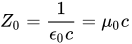
Speed of light
The wave velocity in a system of identical masses "m" and identical springs of spring constant "k" of any number of dimenstions "n" where each mass is connected to its 2n nearest neighbors only and where the wavelength is large compared to the distance "a" between masses is
The microscopic equations have universal applicability but are unwieldy for common calculations. They relate the electric and magnetic fields to total charge and total current, including the complicated charges and currents in materials at the atomic scale.
The macroscopic equations define two new auxiliary fields that describe the large-scale behaviour of matter without having to consider atomic-scale charges and quantum phenomena like spins. However, their use requires experimentally determined parameters for a phenomenological description of the electromagnetic response of materials.
The above equations are the microscopic version of Maxwell's equations, expressing the electric and the magnetic fields in terms of the (possibly atomic-level) charges and currents present. The microscopic version is sometimes called "Maxwell's equations in vacuum": this refers to the fact that the material medium is not built into the structure of the equations, but appears only in the charge and current terms. The microscopic version was introduced by Lorentz, who tried to use it to derive the macroscopic properties of bulk matter from its microscopic constituents. This is sometimes called the "general" form., but the macroscopic version below is equally general, the difference being one of bookkeeping.
Polarization and magnetization
An external electric field that is applied to a dielectric material, causes a displacement of bound charged elements, its molecules gain electric dipole moment and the dielectric is said to be polarized. Polarization density (or electric polarization, or simply polarization) is the vector field that expresses the volumetric density of permanent or induced electric dipole moments in a dielectric material
A bound charge is a charge that is associated with an atom or molecule within a material. It is called "bound" because it is not free to move within the material like free charges. Positive charged elements are displaced in the direction of the field, and negative charged elements are displaced opposite to the direction of the field. The molecules may remain neutral in charge, yet an electric dipole moment forms.
Polarization can be compared to magnetization, which is the measure of the corresponding response of a material to a magnetic field in magnetism.
The origin of the magnetic moments responsible for magnetization can be either microscopic electric currents resulting from the motion of electrons in atoms, or the spin of the electrons or the nuclei. Net magnetization results from the response of a material to an external magnetic field.
The definitions of electric and magnetic displacements with polarization and magnetization are:
P is the (macroscopic) density of the permanent and induced electric dipole moments in the material, called the polarization density.
Let a volume dV be isolated inside the dielectric. Due to polarization the positive bound charge will be displaced a distance relative to the negative bound charge , giving rise to a dipole moment .
Since the charge bounded in the volume dV is equal to the equation for P becomes:
where is the density of the bound charge in the volume under consideration. It is clear from the definition above that the dipoles are overall neutral and thus is balanced by an equal density of opposite charges within the volume. Charges that are not balanced are part of the free charge.
The charge density displacement field satisfies Gauss's law in a dielectric:
In this equation, is the number of free charges per unit volume. These charges are the ones that have made the volume non-neutral, and they are sometimes referred to as the space charge. This equation says, in effect, that the flux lines of D must begin and end on the free charges. In contrast , which is called the bound charge, is an effective density of the charges that are part of a dipole. In the example of an insulating dielectric between metal capacitor plates, the only free charges are on the metal plates and dielectric contains only dipoles. The net, unbalanced bound charge at the metal/dielectric interface balances the charge on the metal plate. If the dielectric is replaced by a doped semiconductor or an ionised gas, etc, then electrons move relative to the ions, and if the system is finite they both contribute to at the edges.
By the divergence theorem, Gauss's law for the field P can be stated in differential form as:
where ∇ · P is the divergence of the field P through a given surface containing the bound charge density .
In general, P varies as a function of E depending on the medium. In many problems, it is more convenient to work with D and the free charges than with E and the total charge.
Therefore, a polarized medium, by way of Green's theorem can be split into four components.
The bound volumetric charge density:
The bound surface charge density:
The free volumetric charge density:
The free surface charge density:
Displacement current with polarization
Differentiating this equation with respect to time defines the displacement current density (JD), which therefore has two components in a dielectric:
The second term on the right hand side, called polarization current density, comes from the change in polarization of the individual molecules of the dielectric material. Polarization results when, under the influence of an applied electric field, the charges in molecules have moved from a position of exact cancellation. The positive and negative charges in molecules separate, causing an increase in the state of polarization P. A changing state of polarization corresponds to charge movement and so is equivalent to a current, hence the term "polarization current".
The first term on the right hand side is present in material media and in free (empty) space but it does have an associated magnetic field, just as a current does due to charge motion. Some authors apply the name displacement current to the first term by itself.
Thus,
This polarization is the displacement current as it was originally conceived by Maxwell. Maxwell made no special treatment of the vacuum, treating it as a material medium. For Maxwell, the effect of P was simply to change the relative permittivityεr in the relation D = ε0εrE.
Magnetic displacement with magnetization
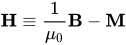
The magnetic-charge density displacement field H0 is defined:
In a vacuum, B and H0 are proportional to each other. Inside a material they are different (see H and B inside and outside magnetic materials). The SI unit of the H0-field is the ampere per metre (A/m), and the CGS unit is the oersted (Oe).
Magnetic displacement current with magnetization
Vector calculus
Vector operators
Standard (2,0) tensor convention used in mathematics, physics, and programming libraries alike:
where:
the first index i → row (vertical position)
the second index j → column (horizontal position)
Noncontracting outer product of a vector and a covector written with standard basis resulting in a (1,1) tensor:
Each component (like ) is a scalar coefficient multiplied times a dyad.
Tensor contraction is denoted by labeling one covariant index and one contravariant index with the same letter, summation over that index being implied by the summation convention. The resulting contracted tensor inherits the remaining indices.
Euclidean (0,2) metric tensor (in Cartesian coordinates):
Lowering indices by tensor contraction with the metric tensor to convert a (1,0) vector to a (0,1) covector (V flat):
(because )
Raising indices by tensor contraction with the inverse metric tensor (, see Kronecker delta) to convert a (0,1) covector to a (1,0) vector (V sharp):
Using Inner product to compute the length of a vector (trivial in Cartesian coordinates in Euclidean space):
Every tensor is the sum of its symmetric part and antisymmetric part:
where:
(symmetric part)
(antisymmetric part)
A tensor A that is antisymmetric on indices and has the property that the contraction with a tensor B that is symmetric on indices and is identically 0.
In this article, the gradient operator is written as to emphasize that it is a covector (1-form), not a vector. This is not a redefinition but a restoration of its true form: the differential of a scalar field f is inherently covectorial, The familiar “vector gradient” used in most texts is obtained only after applying the metric-dependent index-raising operation, In other words, I am not adding a ‘flat’ to the symbol — I am removing an implicit ‘sharp’ that was assumed by historical convention.
The Directional derivative () gives the rate of change of f at a given point when moving an infinitesimal distance in the direction and magnitude specified by the vector v. See Covariant derivative.
Total differential:
The (0,2) Hessian is the gradient of the gradient of a scalar. (The Hessian matrix is a symmetric tensor by the symmetry of second derivatives):
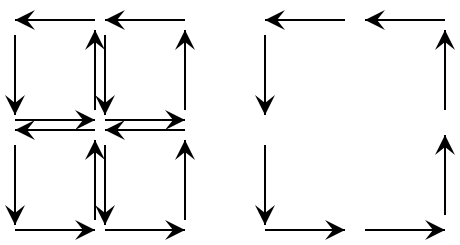
Wedge is used to measure rotation of a field. Rotation from ex to ey is the negative of rotation from ey to ex hence the use of wedge product. Wedge is anti-symmetric but there is no factor of 1/2 because physics doesnt care about idempotency:
Stokes' theorem:
The sum of all the infinitesimal current loops within the 2-D region (Σ) equals the outer current loop (dΣ) alone. This is true for all vector fields.
The Curl only works in 3 dimensions. The curl of the magnetic vector field is the electric current (which generates the magnetic field):
In the xy plane curl measures counterclockwise rotation () corresponding to positive z (out of the page).
Note: It may feel strange to treat a derivative as a (co)vector, since differentiation is an operation, not a quantity. However, the spacetime gradient behaves as if it were a (co)vector because it acts linearly and independently along each coordinate direction.
The Schrödinger equation can be linearized versions of second-order wave equations, just like the Riemann–Silberstein equation for electromagnetism.
For a massless particle (photon), the wave equation is
and it can be factorized as
Each factor corresponds to a one-directional propagation equation:
Schrödinger did the same kind of move but for massive waves.
Adding a rest-mass term and taking the low-velocity limit gives the familiar Schrödinger equation:
So Schrödinger’s equation looks like a diffusion equation with an imaginary diffusion coefficient:
That’s what gives it the oscillatory (wave-like) character.
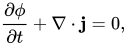
The diffusion equation can be trivially derived from the continuity equation, which states that a change in density in any part of the system is due to inflow and outflow of material into and out of that part of the system. Effectively, no material is created or destroyed:
where j is the flux of the diffusing material. The diffusion equation can be obtained easily from this when combined with the phenomenological Fick's first law, which states that the flux of the diffusing material in any part of the system is proportional to the local density gradient:
Electromagnetic waves
Start with a simple traveling wave:
This says:
The field changes in time exactly as fast as it moves through space — at speed c.
When we move from a 1D scalar wave to a 3D vector wave,
the simple spatial derivative becomes a curl:
That’s exactly the Riemann–Silberstein equation, just without the i in front of time derivative if we pick the right-hand circular polarization convention.
The quantity has the dimension (T/L)2. Defining , the equations above have the form of the standard wave equations
Note about pseudovectors
Unlike the dot product, the cross product depends on a choice of an orientation of the space (this is why the space must be oriented). The cross product is invariant under a rotation of the basis but is changed into its opposite by an odd permutation of the basis vectors. Therefore, the cross product is a pseudovector.
Since position r, linear momentum p and force F are all true vectors, both the angular momentum L and the moment of a force M are pseudovectors or axial vectors.
A vector changes direction under space reflection, while a pseudovector does not. The relationship between electric current and magnetic fields is illustrated by the hand rule, indicating that they cannot both be vectors or pseudovectors. The magnetic field is identified as a pseudovector because it does not change sign under spatial transformations, unlike the electric field, which behaves as a true vector. The electromagnetic field tensor reveals that the electric field is the time-space component, while the magnetic field is the space-space component, confirming their distinct behaviors. Ultimately, under Lorentz transformations, both fields require the complete EM field tensor for accurate representation.
Fields: Gravitational, Gravitomagnetic, Electric, Magnetic
Per = -n, per volume, per area, per distance, per time, per cycle, per degree of freedom
Squared, cubed, 4th power
Inverse or 1/
Negative
Angle as fundamental unit
The Planck constant has the same dimensions as action and as angular momentum (both with unit J·s = kg·m2·s−1). The Planck constant is fixed at = 6.62607015 × 10⁻³⁴ J⋅Hz−1 as part of the definition of the SI units.
Alternatively, if the radian were considered a base unit, then would have the dimension of action (unit J·s), while would have the dimension of angular momentum (unit J·s·rad−1), instead.
This value is used to define the SI unit of mass, the kilogram: "the kilogram [...] is defined by taking the fixed numerical value of h to be 6.62607015 × 10⁻³⁴
when expressed in the unit J⋅s, which is equal to kg⋅m2⋅s−1, where the metre and the second are defined in terms of speed of lightc and duration of hyperfine transition of the ground state of an unperturbed caesium-133 atom ΔνCs." Technologies of mass metrology such as the Kibble balance measure the kilogram by fixing the Planck constant.
Plane angle may be defined as θ = s\r, where θ is the magnitude in radians of the subtended angle, s is circular arc length, and r is radius. One radian corresponds to the angle for which s = r, hence 1 radian = 1 m\m = 1. However, rad is only to be used to express angles, not to express ratios of lengths in general. A similar calculation using the area of a circular sectorθ = 2A\r2 gives 1 radian as 1 m2\m2 = 1. The key fact is that the radian is a dimensionless unit equal to 1. In SI 2019, the SI radian is defined accordingly as 1 rad = 1. It is a long-established practice in mathematics and across all areas of science to make use of rad = 1.
Giacomo Prando writes "the current state of affairs leads inevitably to ghostly appearances and disappearances of the radian in the dimensional analysis of physical equations". For example, an object hanging by a string from a pulley will rise or drop by y = rθ centimetres, where r is the magnitude of the radius of the pulley in centimetres and θ is the magnitude of the angle through which the pulley turns in radians. When multiplying r by θ, the unit radian does not appear in the product, nor does the unit centimetre—because both factors are magnitudes (numbers). Similarly in the formula for the angular velocity of a rolling wheel, ω = v\r, radians appear in the units of ω but not on the right hand side. Anthony French calls this phenomenon "a perennial problem in the teaching of mechanics". Oberhofer says that the typical advice of ignoring radians during dimensional analysis and adding or removing radians in units according to convention and contextual knowledge is "pedagogically unsatisfying".
At least a dozen scientists between 1936 and 2022 have made proposals to treat the radian as a base unit of measurement for a base quantity (and dimension) of "plane angle". Quincey's review of proposals outlines two classes of proposal. The first option changes the unit of a radius to meters per radian, but this is incompatible with dimensional analysis for the area of a circle, πr2. The other option is to introduce a dimensional constant. According to Quincey this approach is "logically rigorous" compared to SI, but requires "the modification of many familiar mathematical and physical equations". A dimensional constant for angle is "rather strange" and the difficulty of modifying equations to add the dimensional constant is likely to preclude widespread use.
In particular, Quincey identifies Torrens' proposal to introduce a constant η equal to 1 inverse radian (1 rad−1) in a fashion similar to the introduction of the constant ε0. With this change the formula for the angle subtended at the center of a circle, s = rθ, is modified to become s = ηrθ, and the Taylor series for the sine of an angle θ becomes:
where
is the angle in radians.
The capitalized function Sin is the "complete" function that takes an argument with a dimension of angle and is independent of the units expressed, while sin is the traditional function on pure numbers which assumes its argument is a dimensionless number in radians. The capitalised symbol can be denoted if it is clear that the complete form is meant.
Current SI can be considered relative to this framework as a natural unit system where the equation η = 1 is assumed to hold, or similarly, 1 rad = 1. This radian convention allows the omission of η in mathematical formulas.
Defining radian as a base unit may be useful for software, where the disadvantage of longer equations is minimal. For example, the Boost units library defines angle units with a plane_angle dimension, and Mathematica's unit system similarly considers angles to have an angle dimension.



![{\displaystyle T^{ij}={\begin{bmatrix}T^{11}\;e_{11}&T^{12}\;e_{12}&T^{13}\;e_{13}\\[3pt]T^{21}\;e_{21}&T^{22}\;e_{22}&T^{23}\;e_{23}\\[3pt]T^{31}\;e_{31}&T^{32}\;e_{32}&T^{33}\;e_{33}\end{bmatrix}}}](https://services.fandom.com/mathoid-facade/v1/media/math/render/svg/a933d0231762ed4cf854fb8c601086dcb360163d)


![{\displaystyle g_{ij}={\begin{bmatrix}1\;e^{11}&&0\;e^{12}\\[3pt]0\;e^{21}&&1\;e^{22}\end{bmatrix}}}](https://services.fandom.com/mathoid-facade/v1/media/math/render/svg/173f29f10415d051ff93f8d23bd3168bcc6dc7d0)
![{\displaystyle {\begin{aligned}V^{\flat }=g_{ij}\;V^{i}e_{i}&={\begin{bmatrix}1\;e^{11}&&0\;e^{12}\\[3pt]0\;e^{21}&&1\;e^{22}\end{bmatrix}}{\begin{bmatrix}V^{1}\;e_{1}\\V^{2}\;e_{2}\end{bmatrix}}\\\\&={\begin{bmatrix}1\;e^{11}*V^{1}\;e_{1}\\1\;e^{22}*V^{2}\;e_{2}\end{bmatrix}}\\\\&={\begin{bmatrix}C_{1}\;e^{1}\\C_{2}\;e^{2}\end{bmatrix}}=C_{j}e^{j}\end{aligned}}}](https://services.fandom.com/mathoid-facade/v1/media/math/render/svg/23d30f763ce9db6133b34b39b4e9ca0cfdca60bb)


![{\displaystyle U_{ij\dots }=U_{\color {red}(ij)}+U_{\color {red}[ij]}}](https://services.fandom.com/mathoid-facade/v1/media/math/render/svg/246f0112494bcc7fab18e9a68bc98b33c5047a3e)

![{\displaystyle U_{\color {red}[ij]}={\frac {1}{2}}(U_{\color {red}ij}-U_{\color {red}ji})}](https://services.fandom.com/mathoid-facade/v1/media/math/render/svg/c2e881a1ed45ff9f85d845270789ae065f58ca2a)


![{\displaystyle \nabla ^{\flat }(\nabla ^{\flat }f)={\begin{bmatrix}{\color {red}{\dfrac {\partial ^{2}f}{\partial x^{2}}}}&{\dfrac {\partial ^{2}f}{\partial x\,\partial y}}&{\dfrac {\partial ^{2}f}{\partial x\,\partial z}}\\[8pt]{\dfrac {\partial ^{2}f}{\partial y\,\partial x}}&{\color {red}{\dfrac {\partial ^{2}f}{\partial y^{2}}}}&{\dfrac {\partial ^{2}f}{\partial y\,\partial z}}\\[8pt]{\dfrac {\partial ^{2}f}{\partial z\,\partial x}}&{\dfrac {\partial ^{2}f}{\partial z\,\partial y}}&{\color {red}{\dfrac {\partial ^{2}f}{\partial z^{2}}}}\end{bmatrix}}}](https://services.fandom.com/mathoid-facade/v1/media/math/render/svg/b9eaa511f991b8ba30b7c12096c2e79249ca93d9)


![{\displaystyle sym(J)={\begin{bmatrix}\partial _{x}f^{x}&{\tfrac {1}{2}}(\partial _{x}f^{y}+\partial _{y}f^{x})&{\tfrac {1}{2}}(\partial _{x}f^{z}+\partial _{z}f^{x})\\[4pt]{\tfrac {1}{2}}(\partial _{y}f^{x}+\partial _{x}f^{y})&\partial _{y}f^{y}&{\tfrac {1}{2}}(\partial _{y}f^{z}+\partial _{z}f^{y})\\[4pt]{\tfrac {1}{2}}(\partial _{z}f^{x}+\partial _{x}f^{z})&{\tfrac {1}{2}}(\partial _{z}f^{y}+\partial _{y}f^{z})&\partial _{z}f^{z}\end{bmatrix}}}](https://services.fandom.com/mathoid-facade/v1/media/math/render/svg/377f573d009234cc1d1751136010ae56c15295af)
![{\displaystyle alt(J)={\begin{bmatrix}0&{\tfrac {1}{2}}(\partial _{x}f^{y}-\partial _{y}f^{x})&{\tfrac {1}{2}}(\partial _{x}f^{z}-\partial _{z}f^{x})\\[4pt]{\tfrac {1}{2}}(\partial _{y}f^{x}-\partial _{x}f^{y})&0&{\tfrac {1}{2}}(\partial _{y}f^{z}-\partial _{z}f^{y})\\[4pt]{\tfrac {1}{2}}(\partial _{z}f^{x}-\partial _{x}f^{z})&{\tfrac {1}{2}}(\partial _{z}f^{y}-\partial _{y}f^{z})&0\end{bmatrix}}}](https://services.fandom.com/mathoid-facade/v1/media/math/render/svg/c93850ec88fb09d3c4466bb23955658ee881d051)

![{\displaystyle {\begin{aligned}\nabla ^{\flat }\wedge \mathbf {\vec {F^{\flat }}} (x,y,z)_{ij}&=(e^{i}\partial _{i})\wedge (f_{j}e^{j})\quad =\quad (\partial _{i}f_{j})\;e^{i}\wedge e^{j}\\\\&=(e^{i}\partial _{i})\otimes (f_{j}e^{j})-(f_{j}e^{j})\otimes (e^{i}\partial _{i})\quad =\quad \partial _{i}f_{j}\;e^{i}e^{j}-\partial _{i}f_{j}\;e^{j}e^{i}\\\\&{\overset {n=3}{=}}(\partial _{x}f_{y}-\partial _{y}f_{x})\;e^{x}\otimes e^{y}\;+\;(\partial _{y}f_{z}-\partial _{z}f_{y})\;e^{y}\otimes e^{z}\;+\;(\partial _{z}f_{x}-\partial _{x}f_{z})\;e^{z}\otimes e^{x}\\\\&{\overset {n=3}{=}}{\begin{bmatrix}0&\partial _{x}f_{y}-\partial _{y}f_{x}&\partial _{x}f_{z}-\partial _{z}f_{x}\\[4pt]-(\partial _{x}f_{y}-\partial _{y}f_{x})&0&\partial _{y}f_{z}-\partial _{z}f_{y}\\[4pt]-(\partial _{x}f_{z}-\partial _{z}f_{x})&-(\partial _{y}f_{z}-\partial _{z}f_{y})&0\end{bmatrix}}\\\\&{\overset {n=3}{=}}{\begin{vmatrix}\mathbf {e} ^{y}\wedge \mathbf {e} ^{z}&\mathbf {e} ^{z}\wedge \mathbf {e} ^{x}&\mathbf {e} ^{x}\wedge \mathbf {e} ^{y}\\[6pt]{\dfrac {\partial }{\partial x}}&{\dfrac {\partial }{\partial y}}&{\dfrac {\partial }{\partial z}}\\[6pt]f_{x}&f_{y}&f_{z}\end{vmatrix}}\\\\&{\overset {n=3}{=}}\left({\frac {\partial f_{z}}{\partial y}}-{\frac {\partial f_{y}}{\partial z}}\right)\mathbf {e} ^{y}\wedge \mathbf {e} ^{z}\quad +\quad \left({\frac {\partial f_{x}}{\partial z}}-{\frac {\partial f_{z}}{\partial x}}\right)\mathbf {e} ^{z}\wedge \mathbf {e} ^{x}\quad +\quad \left({\frac {\partial f_{y}}{\partial x}}-{\frac {\partial f_{x}}{\partial y}}\right)\mathbf {e} ^{x}\wedge \mathbf {e} ^{y}\end{aligned}}}](https://services.fandom.com/mathoid-facade/v1/media/math/render/svg/2a827863bd9b6e4a0f12556af955d69265be2b99)

![{\displaystyle {\begin{aligned}{\text{curl}}(\mathbf {\vec {F}} )=\nabla \times F&{\overset {n=3}{=}}{\begin{vmatrix}\mathbf {e} _{x}&\mathbf {e} _{y}&\mathbf {e} _{z}\\[6pt]{\dfrac {\partial }{\partial x}}&{\dfrac {\partial }{\partial y}}&{\dfrac {\partial }{\partial z}}\\[6pt]f^{x}&f^{y}&f^{z}\end{vmatrix}}\\\\&{\overset {n=3}{=}}\left({\frac {\partial f^{z}}{\partial y}}-{\frac {\partial f^{y}}{\partial z}}\right)\mathbf {e} _{x}\quad +\quad \left({\frac {\partial f^{x}}{\partial z}}-{\frac {\partial f^{z}}{\partial x}}\right)\mathbf {e} _{y}\quad +\quad \left({\frac {\partial f^{y}}{\partial x}}-{\frac {\partial f^{x}}{\partial y}}\right)\mathbf {e} _{z}\end{aligned}}}](https://services.fandom.com/mathoid-facade/v1/media/math/render/svg/8d9d9269f1c2787572a43cb182af6410676b1743)


![{\displaystyle e_{\mu \nu }F^{\mu \nu }={\begin{bmatrix}{\begin{array}{lllllll}{\color {red}e_{00}0}&&-e_{01}\,D_{tx}\,ic_{0}&&-e_{02}\,D_{ty}\,ic_{0}&&-e_{03}\,D_{tz}\,ic_{0}\\[6pt]{\color {red}e_{10}\,D_{xt}\,ic_{0}}&&{\phantom {-}}e_{11}\,0&&{\phantom {-}}e_{12}\,H_{xy}&&-e_{13}\,H_{xz}\\[6pt]{\color {red}e_{20}\,D_{yt}\,ic_{0}}&&-e_{21}\,H_{yx}&&{\phantom {-}}e_{22}\,0&&{\phantom {-}}e_{23}\,H_{yz}\\[6pt]{\color {red}e_{30}\,D_{zt}\,ic_{0}}&&{\phantom {-}}e_{31}\,H_{zx}&&-e_{32}\,H_{zy}&&{\phantom {-}}e_{33}\,0\end{array}}\end{bmatrix}}}](https://services.fandom.com/mathoid-facade/v1/media/math/render/svg/4282bba660c608815a5ee9f08fa16c65390bdf17)


![{\displaystyle e_{\mu \nu }(*F)^{\mu \nu }\;=\;e_{\mu \nu }{\tfrac {1}{2}}\,\varepsilon ^{\mu \nu \alpha \beta }\,g_{\alpha \gamma }\,g_{\beta \delta }\,F^{\gamma \delta }={\begin{bmatrix}{\begin{array}{lllllll}{\color {red}e_{00}\,0}&&-e_{01}H_{tx}&&-e_{02}H_{ty}&&-e_{03}H_{tz}\\[6pt]{\color {red}e_{10}H_{xt}}&&{\phantom {-}}e_{11}\,0&&-e_{12}\,D_{xy}\,ic_{0}&&{\phantom {-}}e_{13}\,D_{xz}\,ic_{0}\\[6pt]{\color {red}e_{20}H_{yt}}&&{\phantom {-}}e_{21}\,D_{yx}\,ic_{0}&&{\phantom {-}}e_{22}\,0&&-e_{23}\,D_{yz}\,ic_{0}\\[6pt]{\color {red}e_{30}H_{zt}}&&-e_{31}\,D_{zx}\,ic_{0}&&{\phantom {-}}e_{32}\,D_{zy}\,ic_{0}&&{\phantom {-}}e_{33}\,0\end{array}}\end{bmatrix}}}](https://services.fandom.com/mathoid-facade/v1/media/math/render/svg/ba9ace9318bb263020bc1f42e786176508c9a7ea)


![{\displaystyle [x^{\mu }]=\mathrm {m} }](https://services.fandom.com/mathoid-facade/v1/media/math/render/svg/05ec794a4ee86ca424a46494a7bb451ce73dd3d2)

![{\displaystyle [\partial _{\mu }]=\mathrm {m} ^{-1}}](https://services.fandom.com/mathoid-facade/v1/media/math/render/svg/a3f83a36ebb39c1b9632ffded6c4998512f01bd2)
![{\displaystyle [\partial _{0}]=(1/ic_{0})\partial _{t}=s/ms=\mathrm {m} ^{-1}}](https://services.fandom.com/mathoid-facade/v1/media/math/render/svg/118e435b0a337ab93e84a70a8bc5452ef0c0d959)
![{\displaystyle [\mathbf {D} ]=\mathrm {Asm^{-2}} }](https://services.fandom.com/mathoid-facade/v1/media/math/render/svg/03e5f7856183d508431eac0a651a5f779c8a3066)
![{\displaystyle [\mathbf {H} ]=\mathrm {Am^{-1}} }](https://services.fandom.com/mathoid-facade/v1/media/math/render/svg/57da30d42997bdb64b59ea54a57cbb05d8fc17c5)


![{\displaystyle [\rho ]=\mathrm {Cm^{-3}} }](https://services.fandom.com/mathoid-facade/v1/media/math/render/svg/6aaad3aa08bcf3f539c8c7170ae832394083959f)
![{\displaystyle [J^{k}]=\mathrm {Am^{-2}} }](https://services.fandom.com/mathoid-facade/v1/media/math/render/svg/ace68127b1799c7de74c83fbcdde8c2b3e724e74)
![{\displaystyle [J^{0}]=[ic_{0}\rho ]=\mathrm {Am^{-2}} }](https://services.fandom.com/mathoid-facade/v1/media/math/render/svg/33147dd60caa13c95788e9e7fee1cfa1c1625933)

![{\displaystyle [\mu _{0}]=\mathrm {Hm^{-1}} =\mathrm {VsA^{-1}m^{-1}} }](https://services.fandom.com/mathoid-facade/v1/media/math/render/svg/acf31108517db1f0f210ab405dd7a11da86cf240)